Astronomers find clues to the origin of energetic cosmic X-ray flashes
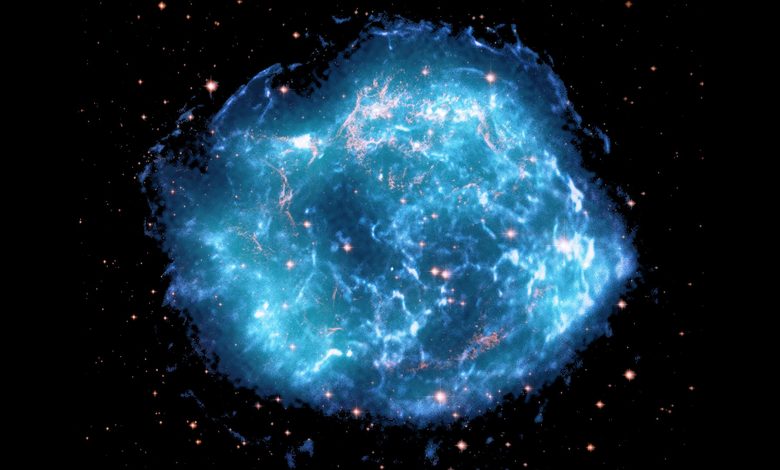
New Delhi ( The Indian View team) : Astronomers have traced the mechanism behind a mysterious celestial non-repeating flash of X-ray called Fast X-ray Transients (FXTs) that was detected on November 7 last year. The study of the X-ray flash which they linked to collapse of a massive star or the merger of two neutron stars could help us better understand the physics of these extreme events.
FXTs are energetic, non-repeating flashes of X-rays associated with violent processes in the universe. They are a new class of transient sources in the sky, first discovered about a decade ago. These enigmatic events appear as sudden bursts of low energy X-rays, lasting from a few minutes to several hours, before fading rapidly from view.
Due to their brief duration, FXTs have long been challenging to study, leaving their origins uncertain. Over the years, astronomers have proposed several possible mechanisms to explain these mysterious flashes. Proposed progenitors of these events include supernova shock breakouts from core-collapse supernovae, neutron stars with extreme magnetic fields rotating every few milliseconds that are formed in the aftermath of binary neutron star mergers, and tidal disruption events involving white dwarfs and intermediate-mass black holes.
Many FXTs are associated with high-redshift long period gamma-ray bursts (lGRBs), while others lack any gamma-ray counterpart, suggesting low-luminosity GRBs or “orphan” afterglows.
A new study led by Deepak Eappachen and Arvind Balasubramanian, both postdoctoral fellows at the Indian Institute of Astrophysics, an autonomous institution under the Department of Science and Technology (DST), focuses on one such FXTs event designated EP241107a, detected on November 7, 2024 by the Einstein Probe mission. This Chinese space mission is designed to survey the dynamic high-energy sky, and is transforming the study of short-lived cosmic events.
Using a multi-wavelength approach, the team discovered a radio counterpart to the X-ray flash using the Karl G. Jansky Very Large Array, located in New Mexico, USA.